
Introduction
Choosing curtains can seem like a simple decorating decision until you actually start shopping. How to Choose Curtains
There are dozens of colors, fabrics, lengths, widths, patterns, and styles to choose from. Then come the practical questions: How wide should the curtains be? Should they touch the floor? How high should the curtain rod be? Do you need blackout curtains or sheer curtains? And how many panels should you actually buy?
Choosing the wrong curtains can make a room feel darker, smaller, unfinished, or visually unbalanced. The right curtains, however, can make windows look larger, add softness, improve privacy, control sunlight, and bring the entire room together.
That’s why learning how to choose curtains is about more than simply picking a color you like.
You need to consider the size of your window, the amount of natural light entering the room, the purpose of the space, your privacy needs, the curtain length, and the overall decorating style.
The good news is that you don’t need to be an interior designer to get it right.
In this complete guide, we’ll walk through everything you need to know before buying curtains—from measuring your windows and choosing the correct width and length to selecting fabrics, colors, and styles for different rooms.
By the end, you’ll have a simple system you can use to choose curtains that look intentional and work properly in your home.
1. Measure Your Window Before Buying Curtains
The first step in choosing the right curtains is also one of the most important: measure before you shop.
Don’t choose curtains based only on the size of the window glass.
You need to consider the entire area you want the curtains to cover, including the space around the window and where you plan to install the curtain rod.
Start by measuring:
- Window width
- Window height
- Distance from the window to the ceiling
- Distance from the window to the floor
- Available wall space on both sides of the window
- Position of nearby furniture
- Door and window clearance
Write these measurements down before shopping.
Measure the Width
Measure the actual window width from one outside edge to the other.
Then decide how far beyond the window you want the curtain rod to extend.
Extending the rod beyond the window can allow the curtains to sit beside the glass when they’re open rather than covering part of the window.
This can make the window appear wider and allow more natural light into the room.
Measure the Height
Measure from where you plan to install the rod down to where you want the curtain to finish.
Don’t automatically measure from the top of the window frame.
The curtain rod may be installed several inches above the window.
how natural light affects your home
This is a natural connection because curtain placement directly affects how much natural light enters the room.
2. How Wide Should Curtains Be?
One of the most common curtain mistakes is buying panels that aren’t wide enough.
Curtains should have enough fabric to create attractive folds when they’re closed. If the panels are barely wider than the window, they can look flat and stretched instead of full and finished.
The amount of curtain fabric you need depends on the width of your window and the fullness you want.
A common approach is to choose total curtain fabric that’s approximately 1.5 to 2 times the width of the area being covered.
For a fuller, more luxurious appearance, you may want additional fabric.
Example
Imagine your window and desired curtain coverage measure 60 inches wide.
Instead of purchasing exactly 60 inches of total curtain width, you might consider approximately:
- 90 inches for lighter fullness
- 120 inches for a fuller appearance
The exact amount depends on the curtain style and manufacturer.
Don’t Confuse Panel Width With Total Width
This is important when shopping online.
If a listing says a curtain panel is 50 inches wide, that may refer to one panel, not the total width of a pair.
Always check:
- Number of panels included
- Width of each panel
- Total width
- Curtain length
This small detail can prevent an expensive ordering mistake.
3. How Long Should Curtains Be?
Curtain length can dramatically change the appearance of a room.
Too short, and curtains can look awkward or unfinished. Too long, and they may bunch excessively on the floor or become difficult to maintain.
For many rooms, floor-length curtains create the most polished appearance.
There are several common ways curtains can meet the floor.
1. Just Touching the Floor
The curtain ends right around floor level.
This creates a clean and tailored appearance.
It’s particularly useful if you want:
- A neat look
- Easy cleaning
- Minimal fabric pooling
- A modern appearance
2. Slightly Above the Floor
The curtain stops just above the floor.
This can be practical when you want less contact with the floor, although a noticeable gap can sometimes make curtains look too short.
3. Slightly Pooled
Extra fabric rests softly on the floor.
This can create a more relaxed or luxurious appearance, but it requires more maintenance and isn’t always practical for high-traffic rooms.
Avoid the “Floating” Look
One of the most common mistakes is curtains that stop several inches above the floor without a specific design reason.
They can make the window treatment look disconnected from the room.
For a polished result, carefully measure the finished curtain length before ordering.
4. How High Should You Hang the Curtain Rod?
The curtain rod doesn’t always need to sit directly above the window frame.
In many rooms, installing it higher can create the impression of a taller window and a more spacious wall.
A common approach is to position the rod several inches above the window frame, depending on the ceiling height and available wall space.
For Standard Ceilings
You can usually install the rod above the window frame while leaving enough room for the curtains to hang naturally.
For Tall Ceilings
You may have more flexibility to move the rod higher.
Some homeowners choose to position curtain hardware closer to the ceiling to emphasize vertical height.
However, don’t automatically mount every curtain rod directly at the ceiling.
The goal is to create a balanced relationship between:
ceiling → curtain rod → window → floor
Another Important Detail
Check your curtain’s rod pocket, grommet, or header style before measuring the final length.
Different hanging styles can change where the fabric actually begins.
🛍️ A Simple Upgrade
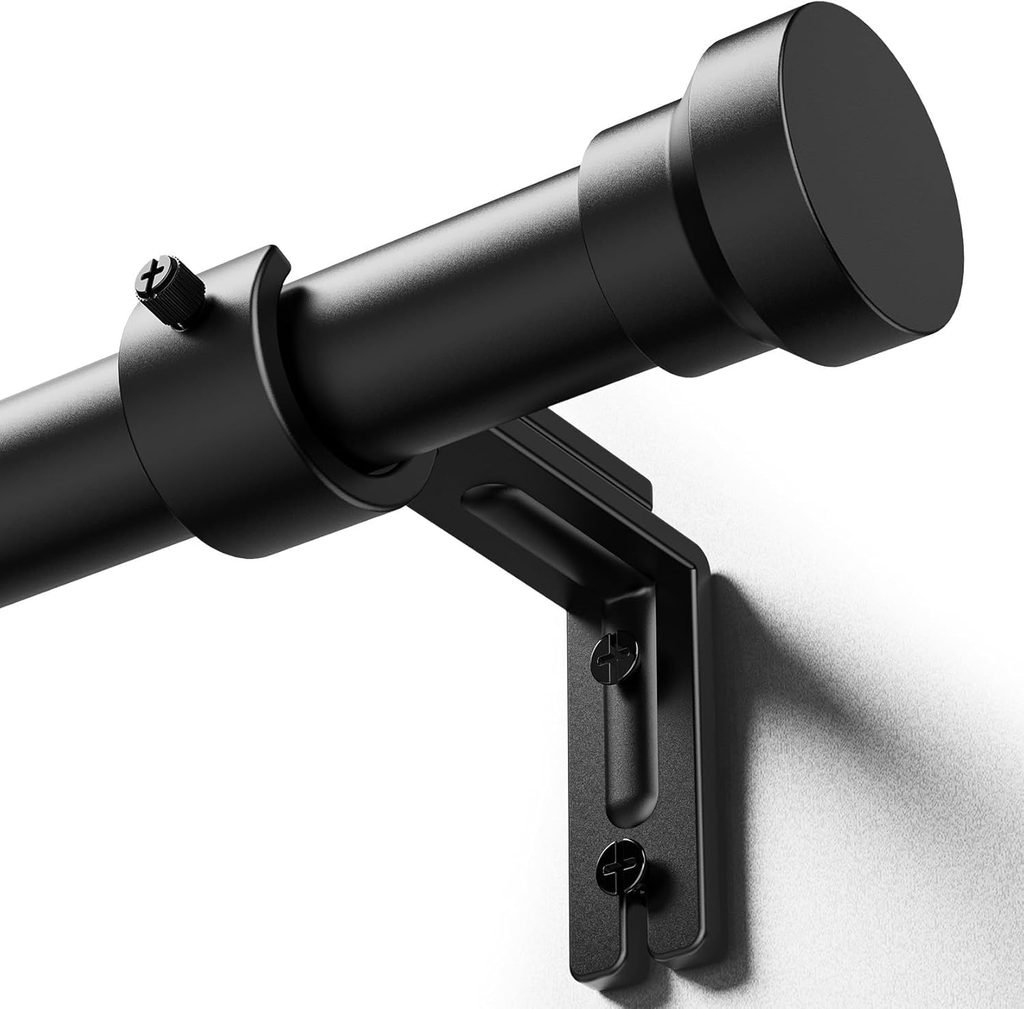
If you’re replacing your curtains, consider upgrading the curtain rod and hardware at the same time.
A sturdy rod with an appropriate finish can make even simple curtains look more intentional.
Look for:
- Correct width
- Strong brackets
- Suitable weight capacity
- Finish that complements your room
- Adjustable length
👉 Check the Latest Price on Amazon
5. How to Choose Curtains for the Living Room
Living-room curtains need to balance appearance and function.
This is usually one of the most visible rooms in the home, so curtains can become an important part of the overall decorating scheme.
Think about:
- How much sunlight enters the room
- Whether you need privacy
- Your furniture colors
- Wall color
- Flooring
- Existing decorative elements
You don’t necessarily need curtains that exactly match your sofa or walls.
Instead, look for a color that works with the existing palette.
For example, if your living room contains warm wood, beige furniture, and cream walls, curtains in a warm neutral tone can reinforce that palette without making everything look identical.
Want a More Decorative Look?
Patterned curtains can become a feature in the room.
But if you already have:
- Patterned rugs
- Bold artwork
- Decorative cushions
- Strong furniture colors
you may want simpler curtains to prevent visual competition.
This helps readers who are already thinking about how curtains should work with their furniture arrangement.
6. How to Choose Curtains for the Bedroom
Bedrooms usually have different curtain requirements from living rooms.
Privacy and light control often become more important, especially if the bedroom faces a street, another building, or receives strong morning sunlight.
Consider Layered Curtains
One useful approach is combining:
Sheer curtains + blackout curtains
During the day, you can use the sheer layer to soften sunlight while maintaining some privacy.
At night, the blackout layer can provide additional darkness and privacy.
For a Peaceful Bedroom
Consider curtains in:
- Soft beige
- Warm white
- Muted gray
- Dusty blue
- Soft green
- Taupe
You don’t have to use neutral colors, but avoid choosing a pattern simply because it looks attractive online.
Think about whether you’ll still enjoy looking at it every morning and evening.
This is an excellent contextual link because bedroom curtains can directly contribute to a calmer atmosphere.
7. How to Choose Curtains for a Small Room
Curtains can either help a small room feel more open or make it feel visually heavy.
The key is to avoid making the window treatment unnecessarily bulky.
Try These Techniques
- Hang curtains slightly above the window
- Extend the rod beyond the window frame
- Choose lighter fabrics
- Use a simple color palette
- Avoid extremely heavy patterns
- Keep curtain folds proportional to the room
Light-colored curtains can also help maintain a brighter appearance, particularly when the room already receives limited natural light.
However, you don’t have to use white curtains.
Cream, soft beige, light gray, and other muted colors can work beautifully.
Suggested anchor text:
This is particularly useful if you’re discussing curtains in a compact bedroom.
8. Sheer vs. Blackout vs. Thermal Curtains: Which Should You Choose?
One of the biggest decisions when buying curtains is choosing the right level of light control.
Not every room needs the same type of curtain. A living room may benefit from soft filtered light, while a bedroom may need much stronger light blocking.
The three common options are sheer, blackout, and thermal curtains.
Sheer Curtains
Sheer curtains are lightweight and allow plenty of natural light to pass through.
They’re useful when you want:
- A brighter room
- Soft filtered sunlight
- A lightweight appearance
- Some daytime privacy
- A layered window treatment
However, sheer curtains usually don’t provide complete privacy at night when indoor lights are turned on.
Blackout Curtains
Blackout curtains are designed to significantly reduce incoming light.
They’re particularly useful for:
- Bedrooms
- Nurseries
- Media rooms
- Rooms facing strong sunlight
- People who prefer darker sleeping environments
They can also provide additional privacy compared with lightweight sheer curtains.
Thermal Curtains
Thermal curtains are designed with materials or construction intended to help reduce heat transfer around windows.
They can be useful in rooms where temperature control is a concern.
However, don’t assume that every thick curtain is automatically a thermal curtain. Check the product specifications before purchasing.
Which One Should You Choose?
Think about what the room actually needs.
| Curtain Type | Light Control | Privacy | Common Use |
|---|---|---|---|
| Sheer | Low | Low–Medium | Living rooms |
| Blackout | High | High | Bedrooms |
| Thermal | Medium–High | Medium–High | Temperature-conscious spaces |
| Layered | Flexible | High | Bedrooms & living rooms |
This makes sense because curtains and window treatments affect how natural and artificial light work together in a room. How to Choose Curtains
9. How to Choose the Right Curtain Fabric
Curtain fabric affects much more than appearance.
It influences how much light enters the room, how the curtains hang, how easy they are to maintain, and how formal or casual the space feels.
Cotton
Cotton curtains can create a clean and relaxed appearance.
They’re often suitable for:
- Bedrooms
- Living rooms
- Casual interiors
- Modern homes
Linen
Linen has a naturally relaxed texture and works particularly well in homes with natural, coastal, minimalist, or casual decorating styles.
Its slightly imperfect texture can make a room feel less formal and more comfortable.
Velvet
Velvet creates a richer, heavier appearance.
It’s often associated with:
- Traditional interiors
- Glamorous rooms
- Luxury-inspired spaces
- Rooms where stronger light blocking is desired
Because velvet can visually feel heavier, consider the room’s size before using it.
Polyester
Polyester curtains are popular because they can be practical, versatile, and available in many styles.
They can work well when you’re looking for:
- Easy-care options
- Affordable curtains
- Many color choices
- Everyday durability
A Simple Rule
Don’t choose fabric based only on how it looks in a product photograph.
Ask:
How should this curtain behave in my room?
If you want soft filtered light, a lightweight fabric may be appropriate.
If you want privacy and darkness, you’ll probably need a denser construction.
If you want a luxurious appearance, heavier fabrics may make more sense. How to Choose Curtains
10. How to Choose the Right Curtain Color
Curtain color can either quietly support your room or become a major visual feature.
There’s no requirement that curtains match your walls exactly.
In fact, using the exact same color can sometimes make the window treatment disappear into the background.
Instead, think about the overall color palette of the room.
Match the Undertone
If your room contains mostly warm colors, consider warm curtain tones.
For example:
- Cream
- Beige
- Taupe
- Warm gray
- Soft brown
For cooler interiors, you might consider:
- Cool gray
- Soft blue
- Muted green
- Blue-gray
Neutral Curtains
Neutral curtains are particularly versatile because they can work with changing decor.
They can also be a good choice if you expect to replace your furniture or artwork later.
Bold Curtains
If the rest of the room is relatively simple, curtains can provide an opportunity to introduce stronger color.
For example, a room with neutral walls and furniture could use muted green, navy, terracotta, or another carefully selected accent shade.
Patterned Curtains
Pattern can add personality, but consider the other patterns already in the room.
If your:
- Rug
- Sofa
- Cushions
- Artwork
are already highly patterned, a simpler curtain may create better balance. How to Choose Curtains
11. How Many Curtain Panels Do You Need?
Another common shopping mistake is misunderstanding how curtain panels are sold.
Some listings include one panel, while others include two panels.
Always check the product description before ordering.
Start With Your Required Width
First determine the total curtain width you need.
For example, if your window coverage requires approximately 100 inches of total curtain width, you might use:
- Two 50-inch panels
- Two 60-inch panels
- Or another combination depending on the desired fullness
The important thing is to calculate the total width, not just look at the width of one panel.
Why Two Panels Are Often Practical
Using two panels allows you to open the curtains from the center.
This can be convenient for:
- Living rooms
- Bedrooms
- Large windows
- Sliding doors
It also creates visual symmetry.
For Narrow Windows
One panel may sometimes be enough, particularly if the window is narrow or you’re creating a simple decorative treatment.
But make sure the finished look doesn’t appear unbalanced. How to Choose Curtains
12. How to Choose Curtains for Large Windows
Large windows can be beautiful, but they also require careful planning.
Wide windows may need multiple panels and stronger curtain hardware.
Consider the Weight
Large curtains can become surprisingly heavy.
Choose a curtain rod and brackets capable of supporting the combined weight of the fabric.
For very wide windows, you may also need additional support in the middle of the rod to prevent sagging.
Think About Opening Space
If the curtains are intended to open fully, make sure there’s enough wall space beside the window for the fabric to stack without covering too much glass.
This is another reason extending the rod beyond the window can be useful. How to Choose Curtains
Large Windows and Natural Light
If the window provides one of the main sources of daylight in the room, avoid automatically choosing very heavy curtains.
Consider whether you actually need complete light blocking.
A combination of sheer and heavier curtains can give you more flexibility.
13. How to Choose Curtains for Small Windows
Small windows can create a different challenge.
If you install a curtain rod exactly within the window frame, the curtains may cover a significant percentage of the glass when they’re open.
One useful approach is to extend the rod beyond the window frame when the wall space allows.
This lets you push the curtains farther to the sides.
You Can Also Emphasize Height
Installing the rod somewhat higher than the window can draw the eye upward and create a stronger sense of vertical height.
However, don’t go so high that the curtains become impractical or disconnected from the window.
Choose Lighter Materials
In a small room, lighter curtain fabrics can help maintain an open appearance.
This doesn’t mean you must use white.
Cream, beige, light gray, soft green, and muted blue can all work depending on your overall palette.
Avoid Overwhelming the Window
Very heavy curtains with extremely large patterns can dominate a small window.
If you want patterned curtains, consider a subtle pattern that works with the rest of the room. How to Choose Curtains
14. Common Curtain-Buying Mistakes to Avoid
Knowing what not to do can be just as useful as knowing what to do.
Here are some of the most common mistakes homeowners make.
Mistake 1: Buying Curtains Before Measuring
Never assume that a standard size will automatically work.
Measure first.
Mistake 2: Buying Panels That Are Too Narrow
Insufficient fabric can make curtains look flat when closed.
Remember to account for fullness.
Mistake 3: Choosing Curtains That Are Too Short
If floor-length curtains are your goal, carefully measure from the actual hanging point to the desired finishing point.
Mistake 4: Installing the Rod Too Close to the Window
Mounting the rod directly above the frame can sometimes make the window appear shorter.
Consider whether raising it slightly would create a better proportion.
Mistake 5: Ignoring the Curtain Header
Grommets, rod pockets, back tabs, and other hanging styles affect how the curtain hangs.
Check the product’s actual finished length.
Mistake 6: Forgetting Door Clearance
Curtains near balcony doors, patio doors, or room entrances need special attention.
Make sure the fabric doesn’t interfere with opening and closing.
Mistake 7: Choosing Style Over Function
Beautiful curtains aren’t useful if they don’t provide the privacy or light control you actually need.
Mistake 8: Ignoring the Rest of the Room
Curtains should work with the furniture, flooring, walls, and other major elements.
They don’t need to match everything—but they should belong to the same visual story.
This is a strong link for readers who want to understand how curtains fit into the overall room design. How to Choose Curtains
15. Curtain Buying Checklist
Before purchasing your curtains, use this quick checklist.
Measure
☐ Window width
☐ Window height
☐ Desired rod width
☐ Rod-to-floor distance
☐ Door clearance
☐ Available wall space
Choose the Function
☐ Light filtering
☐ Privacy
☐ Blackout
☐ Thermal performance
☐ Decorative only
☐ Combination/layered treatment
Choose the Style
☐ Color
☐ Pattern
☐ Fabric
☐ Curtain length
☐ Header style
☐ Rod finish
Check the Product Listing
☐ Number of panels
☐ Width per panel
☐ Curtain length
☐ Material
☐ Washing instructions
☐ Lining
☐ Hardware requirements
Before Ordering
☐ Measure twice
☐ Check the manufacturer’s dimensions
☐ Confirm whether the listed width is per panel or total
☐ Check reviews for actual appearance and quality
☐ Confirm that the curtain rod can support the weight
This checklist can save you from one of the most frustrating decorating experiences: receiving curtains that technically look nice but don’t fit your window properly. How to Choose Curtains
Curtain Size Cheat Sheet
Here’s a quick reference you can keep beside you while shopping.
| What You’re Measuring | What to Consider |
|---|---|
| Window width | Measure the complete window area |
| Curtain width | Allow additional width for fullness |
| Rod width | Usually extend beyond the window when possible |
| Curtain length | Measure from hanging point to desired finish |
| Floor-length curtains | Aim for a clean floor relationship |
| Bedroom | Consider privacy and light control |
| Living room | Balance light, privacy, and appearance |
| Small room | Avoid overly heavy treatments |
| Large window | Check rod strength and center support |
| Door/window combination | Check opening clearance |
How to Choose Curtains Without Overspending
You don’t need expensive curtains to create a polished room.
Instead, spend your budget where it has the biggest impact.
Prioritize Correct Size How to Choose Curtains
A properly sized affordable curtain can look much better than an expensive curtain that’s too short or narrow.
Invest in the Hardware
A sturdy, attractive curtain rod can make inexpensive curtains look more intentional.
Choose Versatile Colors
If you’re decorating on a budget, neutral curtains can make sense because they can work with different furniture and decor styles over time.
Consider Layering
Instead of buying an expensive specialty curtain, you can sometimes combine a simple sheer layer with a heavier curtain to achieve both softness and privacy.
Don’t Forget Maintenance
A curtain that requires complicated cleaning may cost more in the long run.
Before buying, check the care instructions and consider how often the room is used.
Final Thoughts
Learning how to choose curtains becomes much easier when you stop treating curtains as simply another decorative accessory.
They have several jobs to perform.
They can control sunlight, provide privacy, soften a room, improve visual proportions, and contribute to the overall style of your home.
Start by measuring your window carefully. Then decide what you need from the curtains—light control, privacy, insulation, decoration, or a combination of these.
Next, choose the appropriate width, length, fabric, and color.
Most importantly, don’t buy based solely on a beautiful product photograph. Consider how the curtains will actually function in your room.
A well-chosen curtain doesn’t need to be the most expensive item in the room. It simply needs to be the right size, right style, and right function for your space.
And before you place that order, measure one more time.
That extra few minutes can save you from buying curtains that are too short, too narrow, too heavy, or simply unsuitable for your room.