A small home office can be surprisingly difficult to organize.
You may have enough room for a desk and chair, but once you add a monitor, laptop, books, paperwork, chargers, office supplies, and everything else you actually use, the space can start feeling crowded very quickly.
The answer isn’t always a bigger desk or more furniture.
In many cases, the best solution is to use the space you already have more intelligently. Walls, drawers, the area underneath your desk, and even small gaps beside furniture can all become useful storage areas.
Whether you’re working from a dedicated room, a bedroom corner, or a small apartment workspace, these small home office organization ideas can help you create a workspace that feels cleaner, more comfortable, and easier to work in.
1. Use a Desk With Built-In Storage
When space is limited, your desk needs to do more than simply provide a work surface.
A desk with drawers, shelves, or a cabinet can give you storage without requiring another piece of furniture.
Use the drawers for things you reach for regularly, such as notebooks, pens, chargers, and documents. Less frequently used items can go into the deeper storage areas.
If you’re currently choosing a desk, think about the entire workspace rather than just the tabletop size.
A slightly smaller desk with useful storage may actually work better than a large desk that leaves everything sitting out in the open.
If you’re comparing different options, our guide to Best Home Office Desks can help you think about size, storage, and functionality before buying.
2. Take Advantage of Vertical Wall Space
When floor space is limited, look up.
The walls around your desk can provide valuable storage without making the room feel more crowded.
Floating shelves can hold books, small storage boxes, plants, and decorative items. A wall-mounted organizer can keep documents and office supplies within easy reach.
You don’t need to cover the entire wall.
One or two well-placed shelves may be enough to remove clutter from your desk.
Small-space tip: Keep your heavier storage items lower and use higher shelves for lighter or less frequently used items.
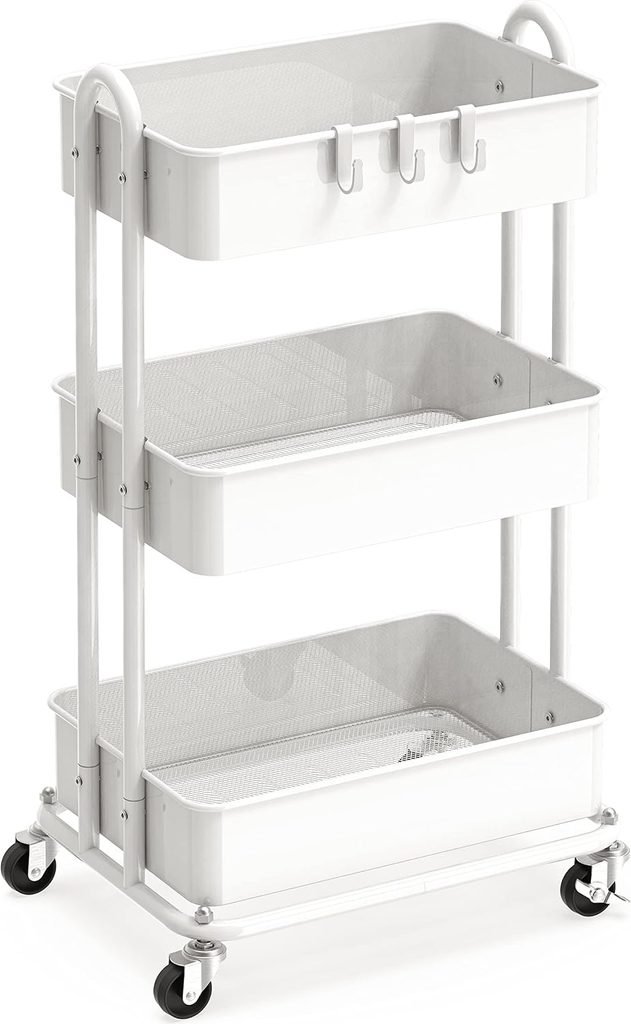
3. Add a Slim Rolling Storage Cart
A slim rolling cart can be one of the most useful additions to a small workspace.
You can place it beside your desk and use it for notebooks, printer paper, office supplies, headphones, or other items that don’t need to stay on the desk.
The biggest advantage is flexibility.
When you need more floor space, simply move the cart somewhere else.
Slim 3-Tier Rolling Storage Cart
Best for: Small offices with limited drawer and cabinet space.
Why it fits: A narrow rolling cart gives you several levels of storage while taking up very little floor space. It can sit beside a desk and keep frequently used supplies accessible without covering the work surface.
Key features:
- Three or more storage levels
- Wheels for easy movement
- Slim design for tight spaces
One thing to consider: Measure the available gap before buying. You want enough room for the cart to move comfortably rather than becoming another obstacle.
Check the Latest Price on Amazon
4. Keep Your Desk Surface Mostly Clear
A clean desk isn’t just about appearance.
When your workspace is covered with notebooks, cables, papers, cups, stationery, and random items, it becomes harder to concentrate.
Try to keep only the things you use regularly on the desktop.
For example, your monitor, keyboard, mouse, lamp, and perhaps one small decorative item might stay visible.
Everything else can have a dedicated storage location.
This is especially important in a bedroom or living room workspace where a messy desk can make the entire room feel more cluttered.
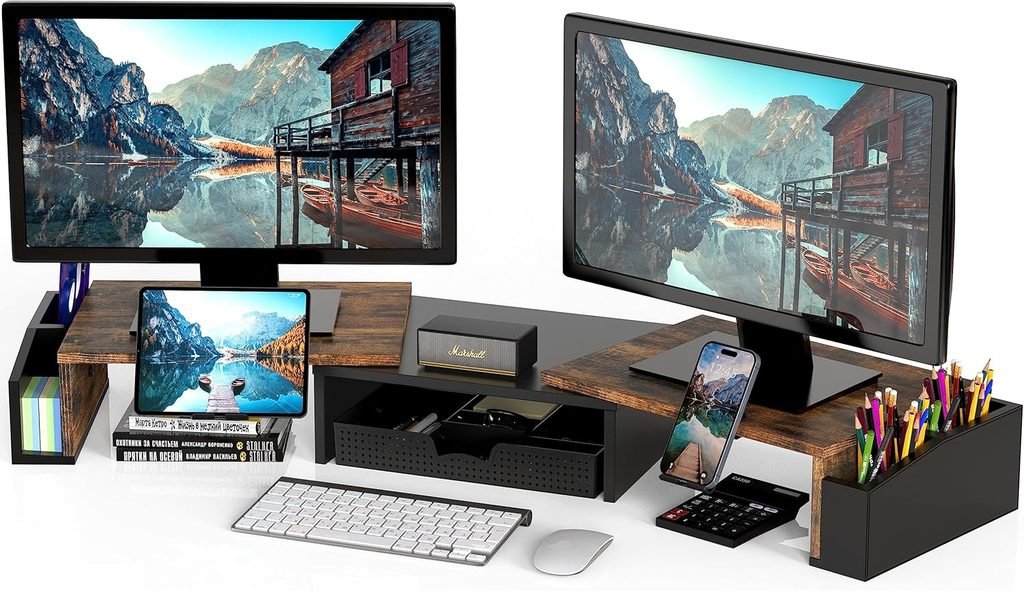
5. Use a Monitor Stand With Storage
If your monitor sits directly on your desk, you’re probably losing a useful piece of vertical space.
A monitor stand can raise the screen to a more comfortable viewing height while creating storage underneath.
The space below can hold a keyboard, notebook, small speakers, or office accessories when you’re not using them.
Monitor Stand With Built-In Storage
Best for: Small desks that need more usable surface area.
Why it fits: Instead of using a separate organizer, a monitor stand can create a small storage zone directly underneath your screen.
Key features:
- Raises the monitor
- Storage space underneath
- Helps organize smaller desk accessories
One thing to consider: Check the stand’s weight capacity and make sure it is appropriate for your monitor.
Check the Latest Price on Amazon
6. Organize Cables and Chargers
Few things make a small home office look messier than tangled cables.
Your laptop charger, monitor cable, phone charger, headphones, and power strip can quickly become one large pile.
Start by identifying which cables you actually use.
Then use cable clips, sleeves, or a cable-management box to keep everything under control.
You can also attach cable clips underneath or along the back edge of your desk so charging cables remain easy to reach without lying across the desktop.
The goal isn’t to hide every cable.
It’s simply to prevent them from becoming visual and physical clutter.
7. Add Wall-Mounted Shelves
If your desk doesn’t have enough storage, don’t immediately replace it with a larger one.
Try adding one or two floating shelves above it.
Shelves are particularly useful for books, small baskets, stationery, plants, and decorative objects.
Just avoid turning the shelves into another clutter zone.
Use baskets or boxes to group smaller items together, and leave some empty space between objects so the area still feels open.
This is also a good place to bring some personality into your workspace without taking up valuable desk space.
8. Create a Small Filing or Document Zone
Paperwork can take over a small home office surprisingly quickly.
Instead of leaving documents in random piles, create one dedicated filing area.
You could use a vertical file holder on your desk, a wall-mounted file organizer, or a small filing box underneath the desk.
Separate documents into simple categories such as:
- Important documents
- Work or business
- Bills
- Current projects
- Papers to deal with later
Don’t create ten different categories if you don’t need them.
A simple system that you actually maintain is much better than a complicated filing system that you stop using after a week.
9. Use Drawer Organizers for Office Supplies
If your desk has drawers, make sure you’re using them efficiently.
Small supplies such as pens, sticky notes, USB drives, scissors, clips, and chargers can easily become mixed together.
Drawer organizers create separate zones so you can find things quickly.
You don’t need an expensive custom system.
Simple adjustable dividers or small trays can work just as well.
Tip: Organize drawers according to how often you use something. Everyday supplies should be easiest to reach.
10. Make Use of the Space Under Your Desk
The area underneath your desk is often wasted.
Depending on the desk design, you can use this space for a small filing box, rolling drawer unit, storage basket, or footrest with storage.
But be careful not to fill every inch.
Your legs need enough room to move comfortably while you’re working.
If the space under the desk becomes crowded, the office may technically have more storage but feel much less comfortable.
Think accessible storage, not maximum storage.
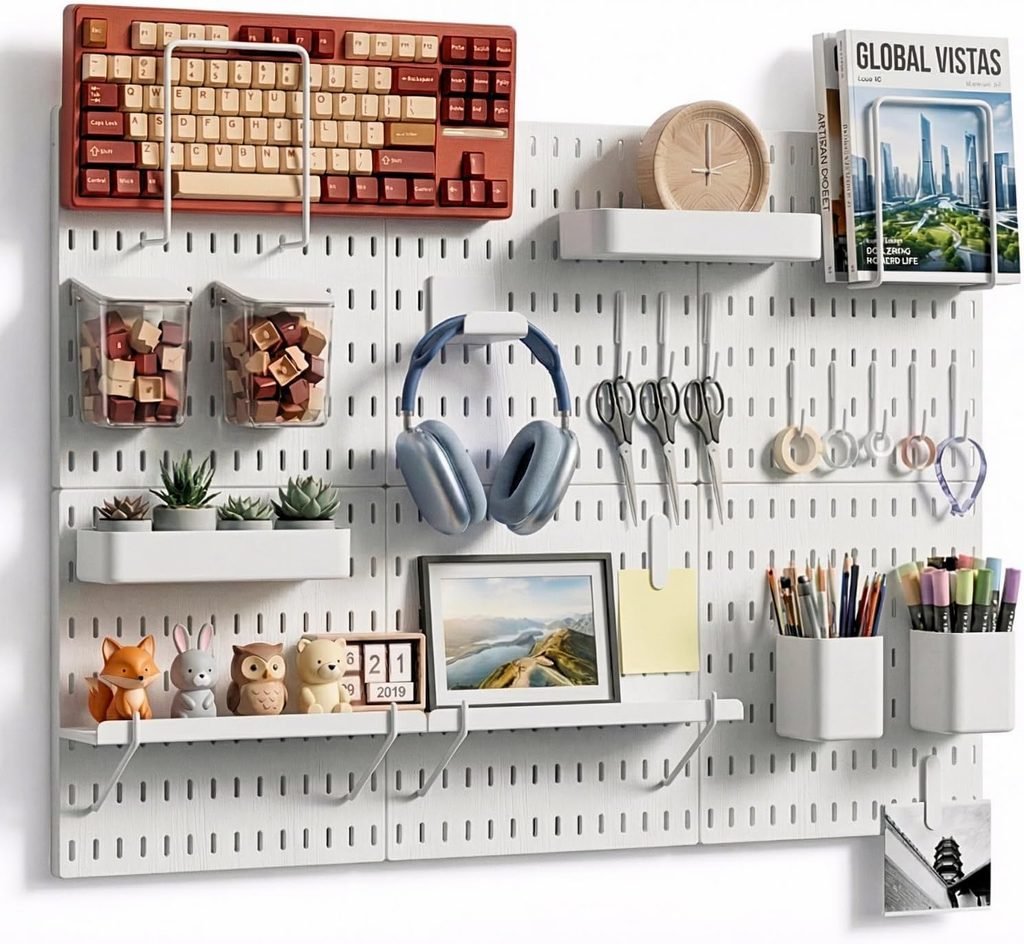
11. Add a Small Pegboard for Everyday Items
A pegboard can turn an empty wall into a flexible organization system.
You can use hooks and small shelves to hold scissors, headphones, stationery, notebooks, cables, and other everyday accessories.
It’s particularly useful when your desk has very little drawer space.
Another advantage is that you can rearrange the hooks as your needs change.
Compact Wall-Mounted Pegboard Organizer
Best for: Small workspaces that need flexible vertical storage.
Why it fits: A pegboard keeps small accessories off the desk while allowing you to change the layout whenever your storage needs change.
Key features:
- Customizable hook arrangement
- Uses vertical wall space
- Suitable for small office accessories
One thing to consider: Don’t overload it with too many small items. A pegboard can look messy if everything you own is hanging from it.
Check the Latest Price on Amazon
12. Use Matching Baskets to Hide Clutter
Open storage is useful, but not everything needs to be visible.
A few matching baskets can make a small home office look much more organized.
Use them for extra cables, paperwork, notebooks, craft supplies, or other items that don’t need to stay on display.
Place baskets on shelves, inside cabinets, or underneath the desk.
If your workspace is part of your bedroom or living room, matching baskets can also help the office area blend into the rest of the room.
This is particularly useful when you don’t have a separate home office.
13. Create a Dedicated Charging Station
Phones, tablets, watches, headphones, and laptops can create a mess of chargers around the desk.
Instead of charging everything in different places, create one small charging zone.
A charging station can sit on the desk, inside a drawer, or on a shelf.
Keep the cables organized and label them if you have several similar chargers.
If you use the workspace every day, this small change can make your morning routine much easier.
You won’t have to search for a charger every time your phone battery is low.
14. Choose Multifunctional Office Accessories
When your office is small, every item needs to justify the space it occupies.
That doesn’t mean you should buy a multifunctional version of everything.
Instead, look for products that genuinely solve two problems at once.
For example, a desk lamp with USB charging can provide lighting and charging. A monitor stand can raise your screen and create storage. A storage ottoman can provide seating and hidden storage if your office doubles as another room.
If you need better lighting for your workspace, our guide to Best Desk Lamps for Home Offices can help you choose one based on the size and setup of your desk.
The key is to choose multifunctional products that you will actually use.
15. Declutter Before Buying More Storage
This is the step many people skip.
Before buying another organizer, shelf, basket, or storage cart, take everything out of your workspace and decide what you actually need.
Do you have notebooks you haven’t opened in years?
Old paperwork?
Broken cables?
Office supplies you bought but never use?
Multiple items that perform exactly the same job?
Getting rid of unnecessary items can sometimes make a bigger difference than buying another storage product.
Once you’ve removed the things you don’t need, organize what’s left.
Storage should solve a problem, not give clutter another place to hide.
Common Small Home Office Organization Mistakes
A small workspace can become difficult to use even when you’ve invested in plenty of storage.
Here are some mistakes worth avoiding.
Buying a Desk That’s Too Large
A large desk may seem useful, but if it leaves no room to move around the workspace, it can make the entire room feel cramped.
Measure the room first.
Then consider the desk width, depth, chair space, and clearance around drawers and doors.
Using Too Many Open Shelves
Open shelves can look beautiful in photos, but they also expose everything.
If every shelf is filled with books, boxes, stationery, decor, and cables, the room can feel visually busy.
Use a combination of open shelves and closed storage when possible.
Keeping Everything on the Desk
Your desk is a workspace, not a storage unit.
Keep the items you use frequently nearby and move everything else into drawers, baskets, shelves, or cabinets.
Ignoring Cable Management
A beautiful desk can still look messy if cables are hanging everywhere.
Deal with cable management early rather than treating it as an afterthought.
Buying Organizers Without Measuring
This is one of the easiest ways to waste money.
Measure the drawer, shelf, cabinet, or gap before buying an organizer.
A product that is one inch too wide isn’t useful.
What Should You Buy First for a Small Home Office?
You don’t need to buy every organization product at once.
Start with the problem that’s bothering you most.
If your desk is always covered with supplies, start with a monitor stand, drawer organizer, or small desk organizer.
If you have unused wall space, consider floating shelves or a pegboard.
If you have limited floor space, a slim rolling cart can provide flexible storage.
If cables are the problem, start with simple cable clips and a cable-management box.
And if the biggest problem is simply too much stuff, don’t buy anything yet.
Decluttering should come first.
Best Amazon Products for Small Home Office Organization
Here are the product categories I’d prioritize when shopping for a small workspace:
| Product | Best For |
|---|---|
| Slim rolling storage cart | Extra storage in narrow spaces |
| Monitor stand with storage | Creating vertical desk space |
| Cable-management box | Hiding power strips and cables |
| Adjustable drawer organizers | Office supplies |
| Floating wall shelves | Books and decorative storage |
| Compact pegboard | Flexible wall organization |
| File organizer | Important paperwork |
| Storage baskets | Hiding visual clutter |
| Desk organizer | Everyday stationery |
| Charging station | Keeping devices and cables together |
The important thing is to buy based on your actual storage problem, not because an organizer looks good online.
Small Home Office Organization Checklist
Before you finish organizing your workspace, check these areas:
☐ Remove things you no longer use
☐ Measure your available space
☐ Keep the desk surface mostly clear
☐ Use vertical wall space
☐ Organize cables and chargers
☐ Give paperwork a dedicated location
☐ Use drawer organizers
☐ Make practical use of the space under the desk
☐ Keep everyday supplies within easy reach
☐ Use baskets to hide visual clutter
☐ Leave enough legroom under the desk
☐ Avoid buying storage you don’t actually need
Final Thoughts
A small home office doesn’t need to look crowded just because it has limited space.
The biggest improvement usually comes from making better use of the space you already have.
Use your walls. Organize your drawers. Keep cables under control. Move less frequently used items away from the desk. And before buying another storage product, take a few minutes to decide whether you actually need it.
A well-organized workspace should make your day easier, not give you another complicated system to maintain.
Start with one problem area today—your desk, cables, paperwork, or storage—and improve it step by step.
Once each item has a place, even a small home office can feel comfortable, practical, and surprisingly spacious.