
Introduction
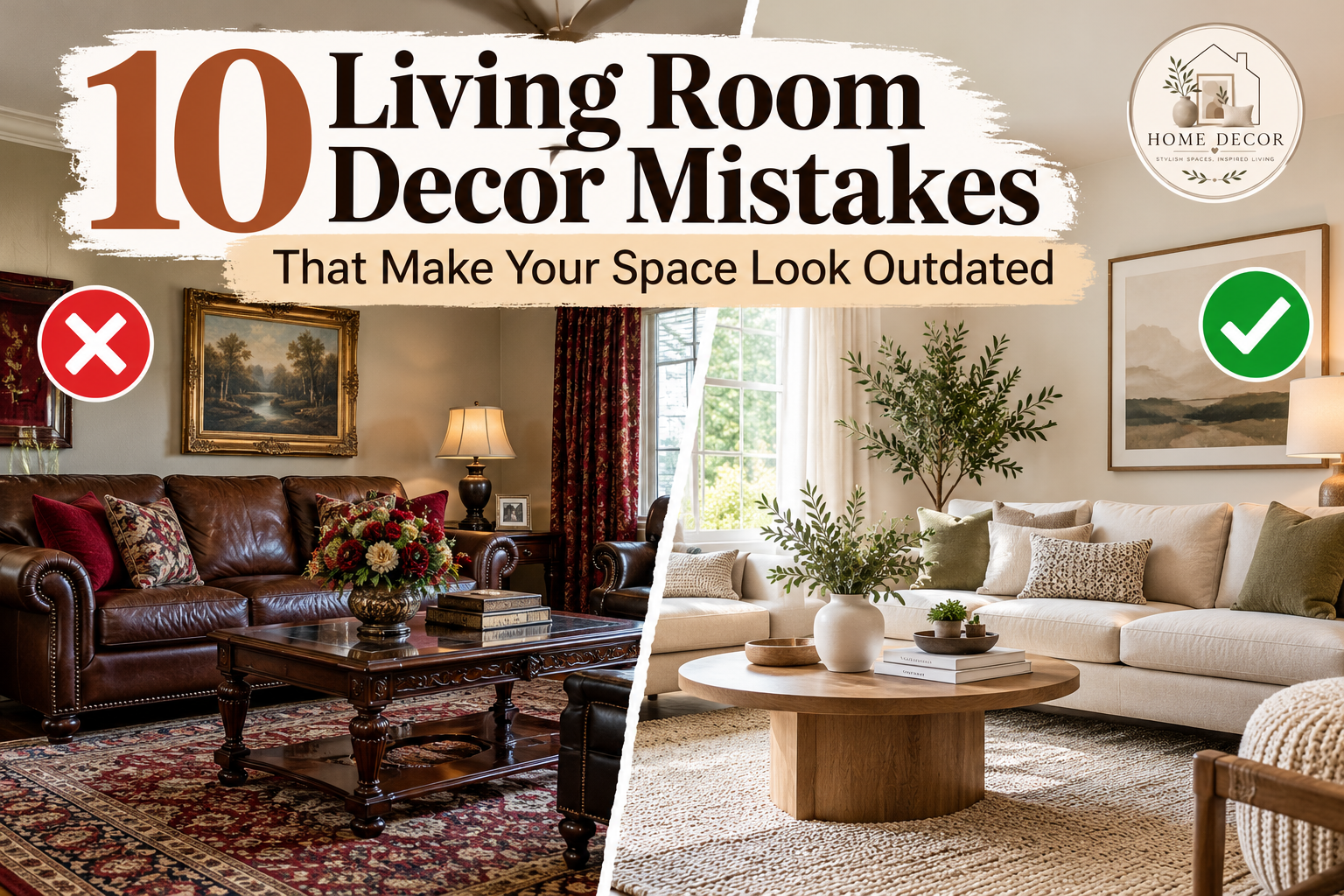
A living room doesn’t have to follow every new design trend to feel current. In fact, trying to make everything perfectly trendy can sometimes have the opposite effect.
A room can start looking outdated because of small details: furniture that is too evenly matched, an undersized rug, outdated lighting, artwork hung too high, or too many decorative accessories competing for attention.
The good news is that you usually don’t need to replace the entire room.
Small changes in furniture placement, lighting, color, scale, and styling can make a living room feel more balanced and up to date.
In this guide, we’ll look at 10 common living room decor mistakes that can make a space look outdated—and what to do instead.
1. Using a Matching Furniture Set
One of the easiest ways to make a living room feel dated is to have every major piece of furniture look like it came from the same collection.
A matching sofa, loveseat, coffee table, side tables, and entertainment unit can make the room feel more like a showroom than a home.
❌ The mistake
Everything matches too perfectly.
Why it can feel outdated
When every piece has the same finish, shape, and design language, the room can lack visual variety.
✅ What to do instead
Try mixing complementary pieces.
For example:
Neutral sofa + wooden coffee table + different-style accent chair + simple side table
The pieces don’t need to match. They just need to work together through shared colors, materials, or proportions.
This is also a good opportunity to use some of the principles from our guide on [mixing different home decor styles].
💡 Product opportunity
If someone already has a matching sofa set, an accent chair can be one of the easiest ways to introduce a different shape or material without replacing the main furniture.
Best for: Updating an existing furniture set without buying an entirely new living room.
Potential drawback: A contrasting chair can look disconnected if its color or scale doesn’t relate to the rest of the room.
👉 Check the Latest Price on Amazon

2. Using a Rug That’s Too Small
This is one of the most common living room styling mistakes.
A beautiful rug can still look wrong if it’s too small for the furniture arrangement.
❌ The mistake
A small rug sits in the center of the room with all the furniture completely outside its edges.
Why it can feel outdated
Instead of visually connecting the seating area, the rug can make the furniture appear scattered.
✅ What to do instead
Whenever possible, choose a rug large enough for at least the front legs of your main seating pieces to sit on it.
For larger rooms, you may want a rug that accommodates most or all of the furniture.
The correct size depends on your room dimensions and furniture layout, so don’t automatically choose a larger rug just because bigger is better.
For more guidance, see our [complete guide to choosing the right rug size for every room].
🛍️ Product opportunity
If your existing rug is clearly undersized, replacing it can make a bigger visual difference than adding several small decorative pieces.
👉 Check the Latest Price on Amazon

3. Pushing Every Piece of Furniture Against the Walls
It might seem logical to push your sofa, chairs, and other furniture against the walls to create more open floor space.
But this can sometimes make the living room feel disconnected and less inviting.
❌ The mistake
Every major piece of furniture is pushed as far toward the walls as possible, leaving a large empty area in the middle.
Why it can feel outdated
The seating area loses its sense of connection. Instead of feeling like a place designed for conversation, the room can start to feel like furniture is simply being stored around the perimeter.
✅ What to do instead
Whenever the room allows it, bring your main seating slightly inward and create a defined conversation area.
For example:
Sofa + two chairs + coffee table
The seating should generally face toward the center rather than simply toward the walls.
You don’t need to leave a huge amount of space between every piece. A comfortable layout that encourages conversation is usually more useful than maximizing empty floor space.
If your living room is small, don’t force this arrangement. Check out our guide to [small living room ideas that make your space feel bigger] for space-saving layouts.
4. Relying on One Ceiling Light
A single bright ceiling fixture can illuminate the room, but it rarely creates the warm and layered atmosphere most living rooms need.
❌ The mistake
One overhead light is responsible for all the lighting in the room.
Why it can feel outdated
Flat, overhead lighting can make a room feel harsh and one-dimensional, especially in the evening.
✅ What to do instead
Create layers of light at different heights.
Try combining:
- Ceiling lighting
- Floor lamps
- Table lamps
- Wall sconces
- Accent lighting
You don’t need every type. Even adding one floor lamp and one table lamp can make a noticeable difference.
Think of lighting as part of the room’s decor rather than something purely functional.
For a deeper explanation, see our guide to [layered lighting for a warm and functional home].
💡 Product opportunity
A floor lamp is one of the simplest upgrades because it adds both lighting and vertical interest.
Best for: Dark corners, reading areas, and living rooms that rely heavily on ceiling lighting.
Potential drawback: A large floor lamp can take up valuable floor space in a compact room, so check its footprint before buying.
👉 Check the Latest Price on Amazon

5. Using Too Much Gray
Gray isn’t automatically outdated. The problem is when everything in the room is the same cool gray tone.
Think gray walls, gray sofa, gray rug, gray curtains, and gray accessories with little contrast.
❌ The mistake
Building the entire living room around one flat, cool neutral.
Why it can feel outdated
A room with too many similar cool tones can lack warmth, contrast, and visual depth.
✅ What to do instead
You don’t necessarily need to replace your gray furniture.
Warm it up with:
- Cream
- Beige
- Caramel
- Warm wood
- Terracotta
- Olive green
- Brass
- Natural woven textures
For example, a gray sofa can look completely different when paired with a warm wood coffee table, cream cushions, a textured beige rug, and warm lighting.
6. Hanging Artwork Too High
Beautiful artwork can still look wrong when it’s positioned too high above the furniture.
❌ The mistake
Leaving a large gap between the top of the sofa and the artwork.
Why it can feel outdated
The artwork becomes visually disconnected from the furniture underneath it.
✅ What to do instead
Treat the artwork and furniture as one visual arrangement.
For artwork above a sofa, keep the gap relatively modest rather than leaving a large empty wall between the two.
Also consider the overall scale.
A tiny piece of artwork above a large sofa can look lost, while one appropriately sized piece—or a thoughtfully arranged gallery wall—can create much stronger balance.
For more ways to deal with bare or awkward walls, see our guide to [empty wall decor ideas for every room].
7. Making Everything Match Too Perfectly
Your living room doesn’t need to look like every piece was purchased from the same furniture collection.
When the sofa, curtains, rug, cushions, artwork, coffee table, and accessories all share the same style and color, the room can lose personality.
❌ The mistake
Trying to make every element perfectly coordinated.
Why it can feel outdated
A room with no contrast can look staged rather than collected. Modern interiors often feel more interesting when different materials, shapes, and finishes work together.
✅ What to do instead
Choose a few elements that connect the room, then allow other pieces to be different.
For example:
Cream sofa + wood coffee table + patterned rug + black floor lamp + woven accessories
They don’t match exactly, but the combination feels intentional.
The goal is coordination, not duplication.
8. Using Too Many Small Decorative Accessories
More decoration doesn’t automatically make a living room look more finished.
In fact, covering every shelf, table, and surface with small objects can make the room feel cluttered.
❌ The mistake
Using lots of small decorative items simply because there is an empty surface.
Why it can feel outdated
When everything competes for attention, individual pieces lose their impact and the room becomes visually noisy.
✅ What to do instead
Try grouping a few larger or more meaningful pieces together.
For a coffee table, for example:
Tray + vase + book + small decorative object
Instead of:
10 tiny objects scattered across the entire surface.
Also leave some intentional empty space. It gives your favorite pieces room to stand out.
If you want a polished room without filling every surface, our guide on [home styling tips that make any room look more put together] is a useful next step.
9. Choosing Furniture That’s Too Large—or Too Small
Furniture scale is one of the easiest things to overlook when decorating a living room.
A sofa can look beautiful online but completely overwhelm a small room. Likewise, tiny furniture can make a large living room feel strangely empty.
❌ The mistake
Choosing furniture based only on appearance without considering the room’s dimensions.
Why it can feel outdated
Poor proportions can make the entire layout feel awkward, even when every individual piece looks good.
✅ What to do instead
Before buying furniture, measure:
- Room width and length
- Doorways and walkways
- Sofa dimensions
- Coffee-table dimensions
- Distance between seating
- Available wall space
Then think about visual weight, not just measurements.
A bulky dark sofa may visually dominate a room more than a lighter-colored sofa of similar dimensions.
10. Decorating Only for Trends
Following every new interior trend can make a room feel less personal—and ironically, it can make the space look dated faster.
❌ The mistake
Replacing your decor whenever a new trend becomes popular.
Why it can feel outdated
Trends change. A room built entirely around one specific aesthetic can quickly look like a snapshot of a particular design period.
✅ What to do instead
Use trends as inspiration, not as a complete decorating formula.
Keep your larger investments relatively timeless:
- Sofa
- Flooring
- Major furniture
- Curtains
- Large rugs
Then experiment with trends through easier-to-change pieces:
- Throw pillows
- Artwork
- Lamps
- Vases
- Small decorative objects
- Accent colors
This gives you the flexibility to update your room without constantly buying new furniture.
🏠 Quick Living Room Update Checklist
Before buying anything new, walk around your living room and ask:
☐ Is my rug large enough for the seating arrangement?
☐ Does my furniture actually fit the room?
☐ Is everything matching too closely?
☐ Do I have more than one source of lighting?
☐ Is my artwork appropriately scaled and positioned?
☐ Does the room have enough warm or natural materials?
☐ Are my surfaces overcrowded?
☐ Am I decorating for my lifestyle or simply following a trend?
You may discover that the best update isn’t buying more decor—it’s rearranging, removing, or replacing one poorly scaled piece.
Final Thoughts
A living room doesn’t become outdated simply because it isn’t following the newest design trend.
More often, the problem comes from poor scale, limited lighting, excessive matching, clutter, or a layout that doesn’t work for the people using the space.
Before replacing everything, look for the small things that are making the room feel disconnected.
Start with the biggest visual problems—such as an undersized rug, poor furniture arrangement, harsh lighting, or overcrowded surfaces. Then make smaller styling changes around them.
The goal isn’t to create a room that looks trendy for one year.
It’s to create a living room that feels comfortable, balanced, personal, and intentionally designed.


